Designing a Dressing Room or Walk-In Wardrobe: Is Your Space Big Enough?
There's a tier of fitted furniture beyond even a full wall of wardrobes: the dressing room. An entire room — or a generous walk-in extension of a bedroom — given over to clothes, shoes, accessories, and the routines of getting dressed. For London homeowners with a spare bedroom, a large loft conversion, or a period property with generous proportions, a properly designed dressing room is one of the highest-value uses a room can be put to, practically and emotionally.
But not every "might fit" space actually works as a walk-in. The difference between a dressing room that feels like a boutique and one that feels like a cupboard with ambitions is almost entirely down to three things: the proportions of the space, the layout you choose for it, and the interior spec. This guide walks through all three, plus the honest counter-question every designer should raise: Is a walk-in actually the right answer for your property, or would a beautifully executed wall of fitted wardrobes serve you better?
Humphries Cabinets builds bespoke wardrobes, walk-in wardrobes, and fitted cabinetry across every London borough within the M25. This article draws on their approach — but whether the answer for your home is a dressing room, a walk-in, or something more compact, the conversation starts the same way: with a proper look at the space.
Dressing Room Or Walk-In Wardrobe — What's The Difference?
The two terms get used interchangeably, but they describe different things.
A walk-in wardrobe is, essentially, a wardrobe you can step into. It's usually an extension of a bedroom — sometimes behind a set of doors, sometimes via a separate entrance — sized generously enough for you to stand inside while choosing clothes, rather than reaching in from outside. Walk-ins typically carry hanging and storage on one side, two sides, or three sides, depending on the proportions of the space.
A dressing room is a standalone room dedicated to dressing — a room in its own right, with its own door, typically converted from a spare bedroom or carved out of an over-generous primary bedroom. A dressing room will usually include everything a walk-in does, plus features that need more floor space: an island or central unit, seating, and sometimes a dedicated vanity or makeup area.
In practice, the distinction matters less than the design. A well-designed walk-in can feel like a dressing room, and a small dressing room can be less functional than a thoughtfully specified walk-in. What matters is whether the space supports what you actually want to do in it.
The Four Main Layouts, And When Each One Works
Walk-ins and dressing rooms broadly follow four layout archetypes. The right one for your space depends less on a mathematical minimum and more on the proportions you're working with — long and narrow, square, or large and open — and on what you want the room to feel like.
Galley Layout (Clothes On Two Opposite Sides)
The most common walk-in configuration. Hanging and storage runs along two parallel walls, with a clear walkway down the middle. Works well in long, narrow spaces — including converted alcoves behind a bedroom wall, spaces carved out of a master suite, or long corridor-like rooms that don't work as sleeping rooms.
The galley is efficient because every inch of wall is used, and nothing is wasted on corners. The risk is feeling cramped if the space is too narrow — you need enough clear walkway that two doors from opposite sides can open simultaneously without clashing.
L-Shape layout
Hanging and storage runs along two adjacent walls that meet at a corner, leaving the remaining two walls free (usually for a door, a window, or a mirror). Good for box rooms, converted loft spaces with one awkward angle, and spaces where a full galley would feel tight.
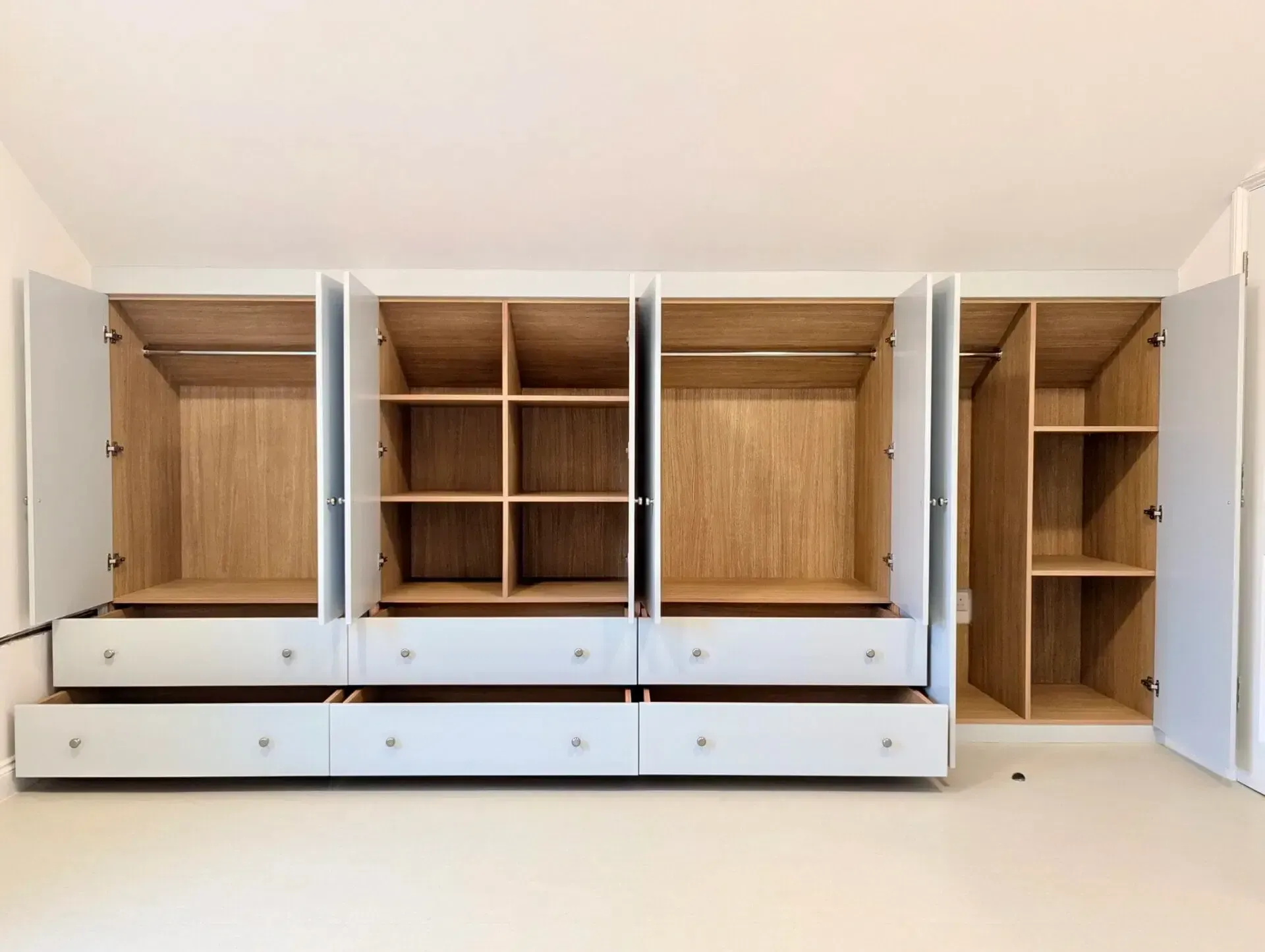
The L-shape is often the best answer for loft conversions with sloping ceilings — Humphries builds custom-shaped wardrobes and loft eave units specifically to follow the angles of these rooms, turning the awkward corner into usable hanging space rather than a dead zone.
U-Shape Layout
Three walls of clothes, with the door (and sometimes a mirror or seating) on the fourth wall. A U-shape walk-in feels like a small boutique — you step in, and clothes are visible on three sides. It's particularly good for square-ish rooms, and it delivers the strongest visual impact of any walk-in layout.
The trade-off is that corners lose some hanging efficiency (the two inside corners where walls meet are awkward to fit cleanly), and the layout needs enough floor space that you can stand in the middle and turn without feeling enclosed.
Island-Centred Dressing Room
A full dressing room with a central island — a freestanding unit in the middle of the room, typically containing drawers, folded-clothes storage, jewellery drawers, or a vanity surface. The island is the feature that separates a dressing room from a generous walk-in, and it changes how the room is used: instead of reaching into a drawer bank on the wall, you can lay clothes out on the island, use it as a packing surface, or sit alongside it to put on shoes.
This layout needs meaningful floor space — enough that there's a generous walkway on all sides of the island, not just two sides. If the island ends up too close to the hanging, the room stops functioning and becomes a display piece.
For all four layouts, Humphries produces a full 3D drawing package as part of the design process, so you can see exactly how the proposed layout will work in your specific room before anything is built. Walking through the drawings is often the clearest way to tell whether a layout that looks fine on paper will actually feel right in the space.
Converting A Spare Bedroom Into A Dressing Room
The most common route to a dressing room in a London property is converting a spare bedroom. A few practical considerations:
Keep the existing door where possible. The door between the master bedroom and the spare is often the most natural entry point for a dressing room. Repositioning the door to create a connected suite (or blocking up the original corridor access) is a renovation decision, not a furniture one — worth thinking through before commissioning fitted work.
Lighting is not optional. A dressing room with weak lighting defeats its own purpose. More on this below, but the short version: plan lighting before the wardrobes go in, not after.
Heating and ventilation continue to matter. The room was designed as a bedroom with radiators, windows and vents positioned accordingly. Any fitted-furniture design has to work around these — or coordinate with a decorator to reposition them if the budget allows. Windows in particular shouldn't be covered by hanging; if the dressing room has a window, the design needs to work around it.
Resale implications. A dressing room converted from a spare bedroom technically reduces the "bedroom count" of the property, which can affect resale — especially for family buyers who value bedroom numbers. Two considerations soften this:
- If the dressing room is clearly reversible (fitted furniture rather than built-in structural work), future buyers can restore it as a bedroom.
- In higher-end London properties where a primary suite with dressing room is itself a selling feature, the loss of the third or fourth bedroom may be more than offset by the premium positioning of the main suite.
This is a conversation worth having with both your estate agent and your fitted-furniture designer before committing.
Lighting — The Detail That Changes Everything
Lighting is what separates a dressing room that works from one that doesn't. Poor lighting makes colours read wrong when choosing outfits, casts shadows in drawer contents, and turns a premium space into a frustrating one.
Elements worth thinking about at the design stage
Integrated LED lighting inside wardrobes. Humphries can work with your electrician to incorporate internal LED lights that switch on automatically when the wardrobe doors open — a genuinely useful feature in any fitted wardrobe, and close to essential in a walk-in.
Under-shelf LED strips illuminate the contents of each shelf without the contents of the shelf above casting a shadow.
Ambient room lighting at a neutral-to-daylight colour temperature, so clothes look the colour they actually are, rather than yellowed or blueish.
A feature pendant or statement fitting in an island-centred dressing room — both functional and finishing the room aesthetically.
Mirror lighting. If a full-length mirror is part of the dressing room, it needs to be well-lit for the mirror to be useful.
Because lighting requires electrical work, it's typically best coordinated with your electrician alongside the furniture design — Humphries can advise on what's buildable into the furniture, but the electrical installation itself sits with your electrician and may fall under Part P of the Building Regulations.
When A Wall Of Wardrobes Serves You Better Than A Walk-In
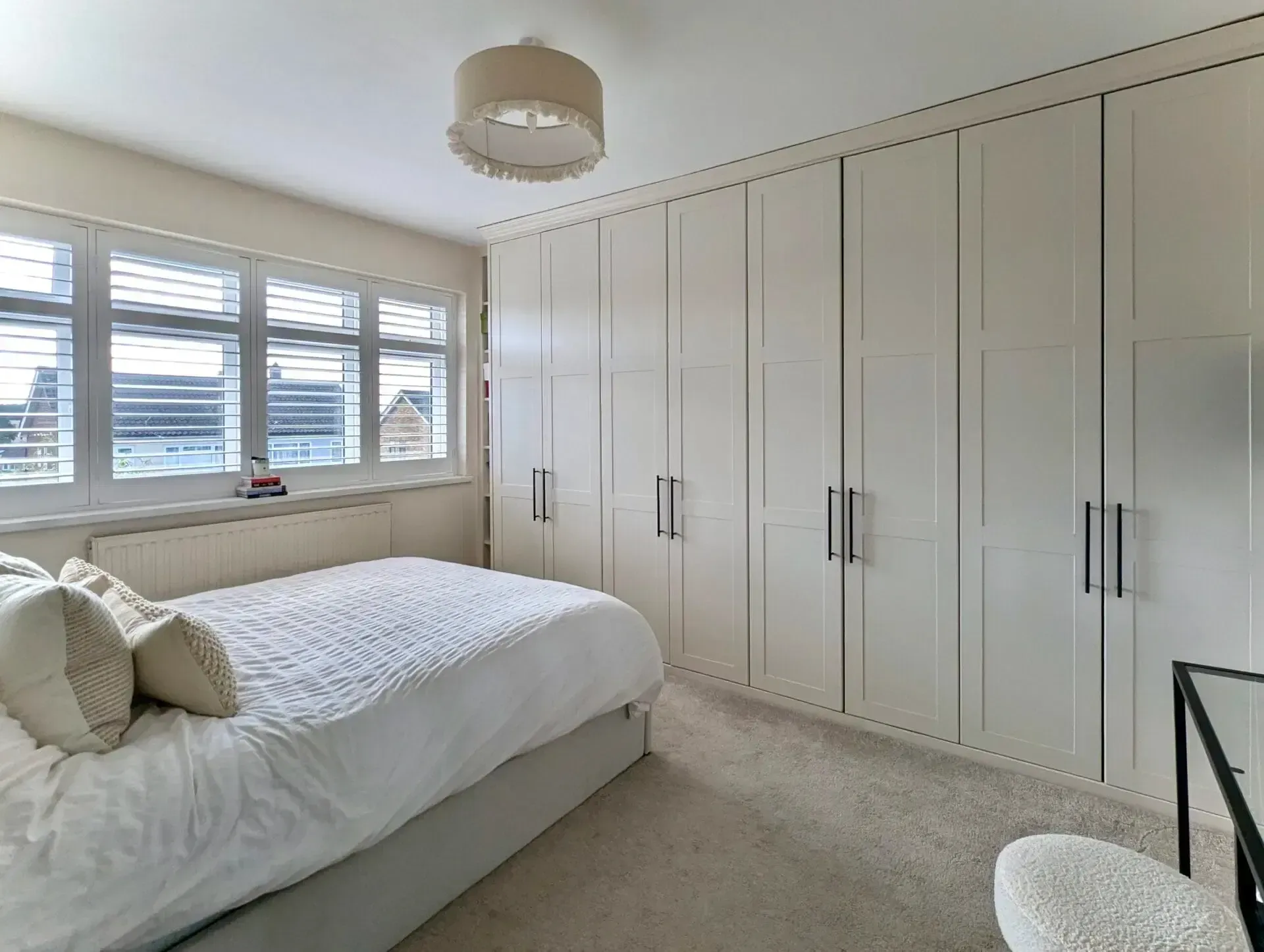
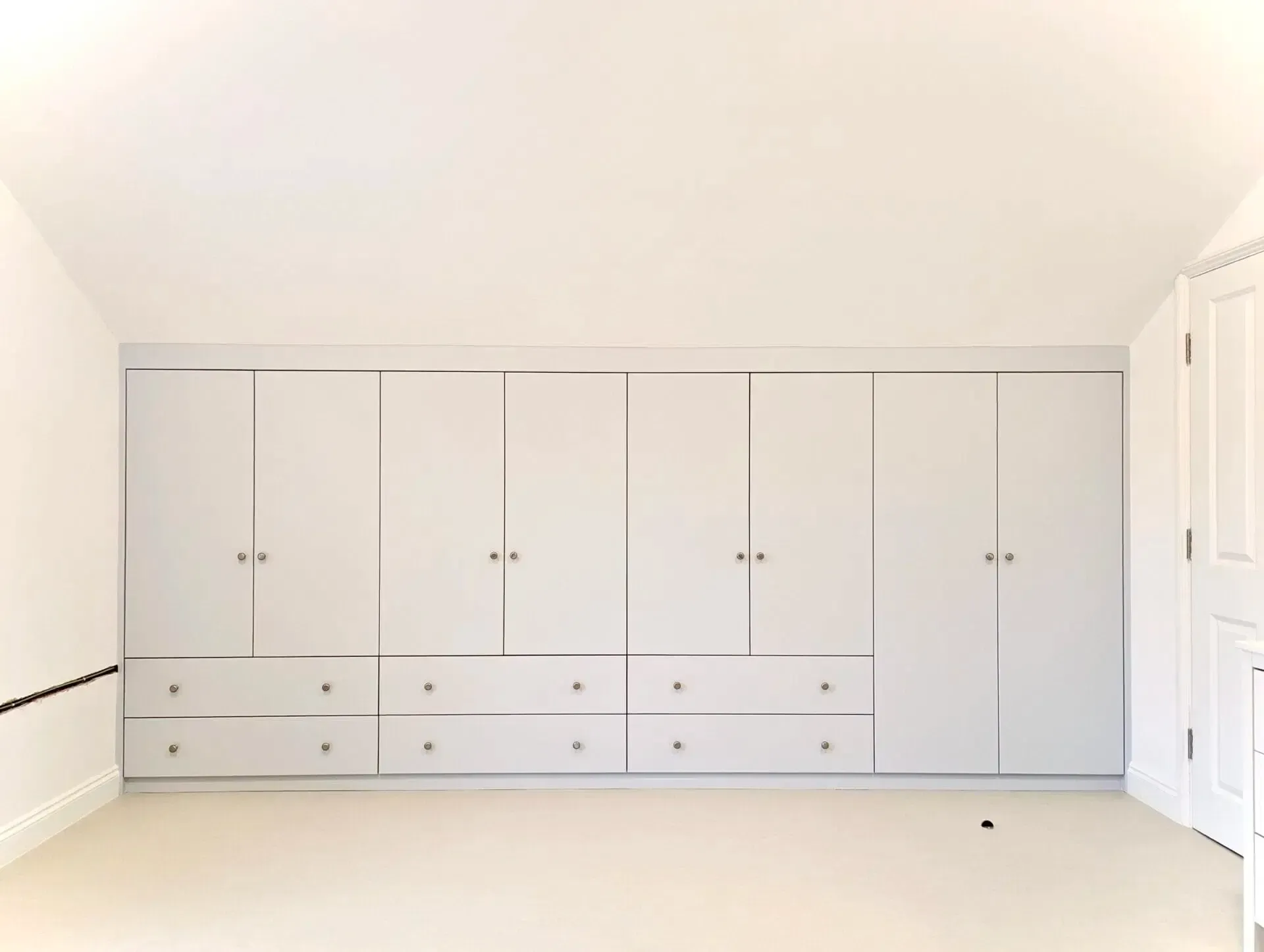
Worth saying directly: a walk-in or dressing room is not automatically the right answer. For many London properties, a beautifully executed full wall — or full-room — of fitted wardrobes delivers more of what the client actually wants, without the downsides.
Consider staying with a wall of fitted wardrobes when:
- You don't have a genuinely spare room. Losing a bedroom for a dressing room means losing a bedroom at resale, and in space-constrained London housing, that's a meaningful trade-off.
- The potential dressing room is small. A true walk-in needs enough space to be comfortable. A cramped walk-in with clothes crammed on two sides and no room to turn around isn't a premium feature — it's a compromise.
- Storage is the primary need, not the experience. If what you actually want is more capacity, a full-wall of floor-to-ceiling fitted wardrobes in the main bedroom often delivers more hanging and folded storage than a small walk-in would, with the bedroom intact.
- The room has awkward proportions for the layouts described above. A long, thin space that isn't quite right for a galley, or a square-ish space that isn't quite big enough for a U-shape, may deliver a better result as a bank of fitted wardrobes along one or two walls.
- Budget prioritises quality over scale. A smaller, premium-specified fitted wardrobe installation may deliver a better finished experience than a larger walk-in at the same overall investment.
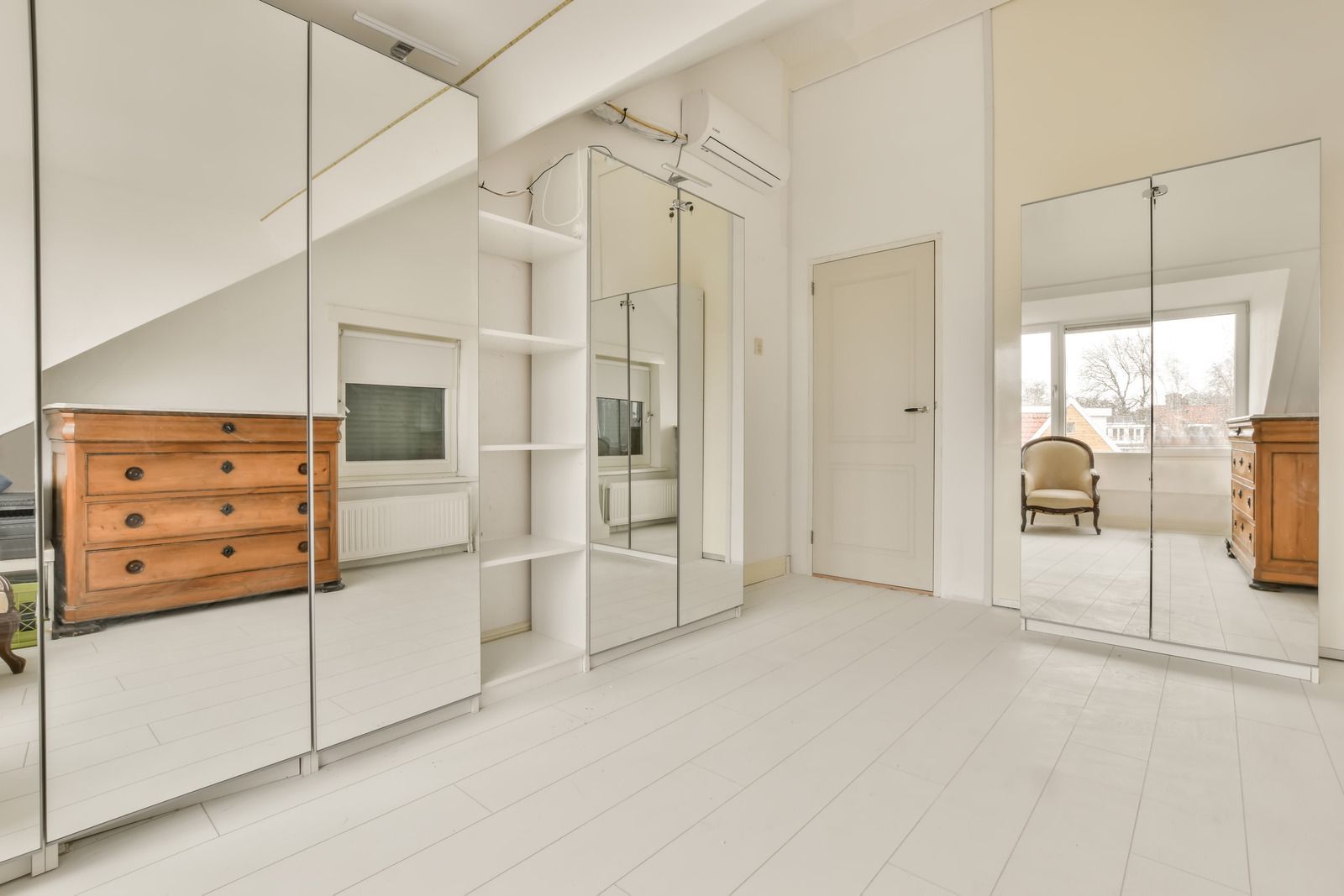
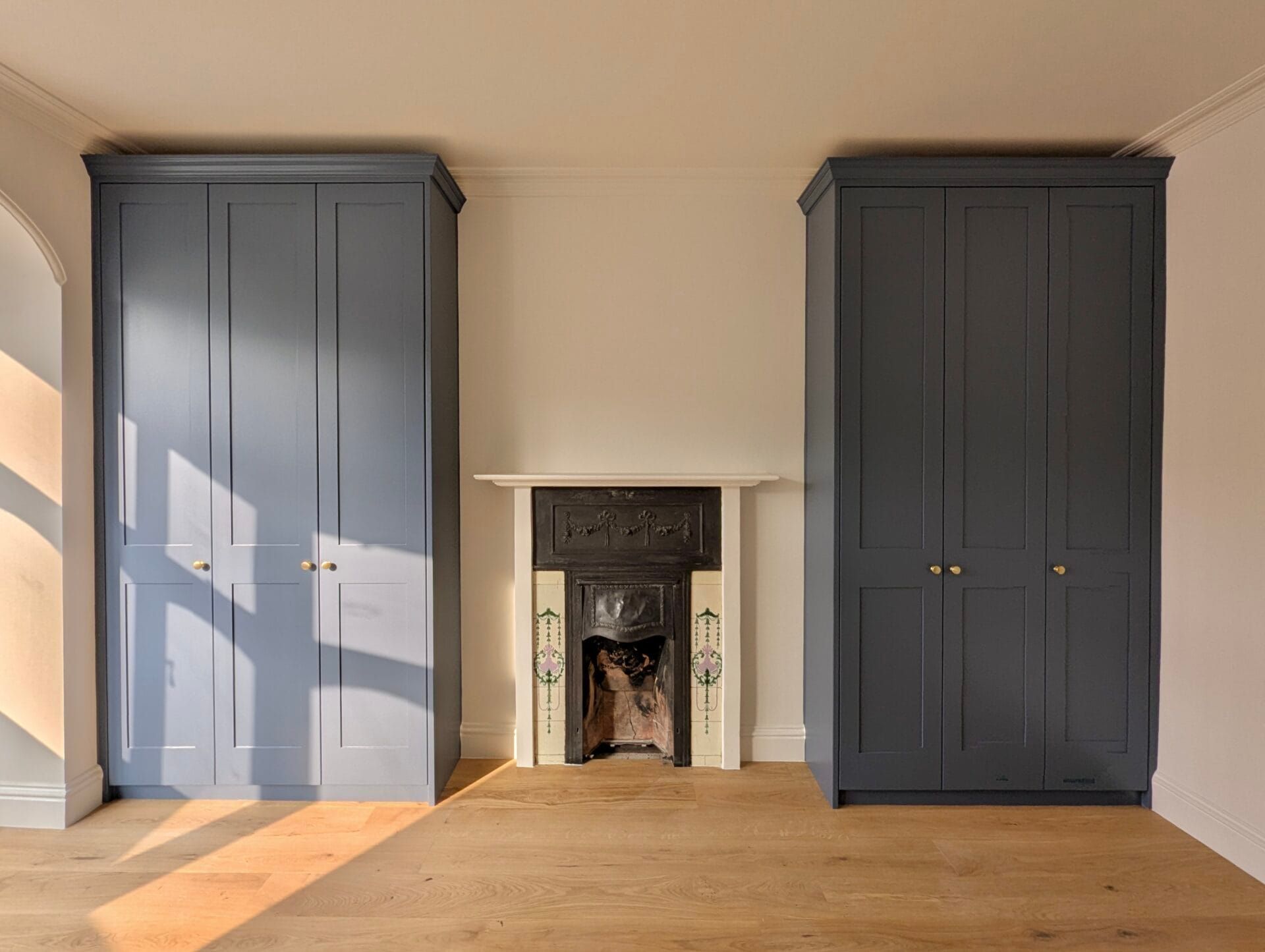
Humphries builds full-wall fitted wardrobes — including floor-to-ceiling configurations, mirror-fronted wardrobes, and integrated cabinetry that combines hanging, drawers and shelving across a full wall — exactly because this answer is the right one for many London homes. The design visit is the place to have an honest conversation about whether a walk-in or a wall of wardrobes is actually right for your space.
Essential internal fittings for a dressing room
The fitted interior is where a dressing room earns its keep. Humphries puts particular emphasis on interiors, measuring existing hanging rail usage during the design visit and building interiors specifically around how you actually use clothes. The usual elements:
Double-Hanging Zones
one rail above another — maximise hanging capacity for shirts, jackets and folded-hang items.
Long-Hanging Zones
for dresses, coats and long trousers that don't fit under double-hanging.
Drawer Banks With Dividers
for folded items, underwear, socks, scarves and accessories.
Pull-Out Trouser Racks
and similar specialised hanging for items that benefit from horizontal storage.
Shoe Storage
tailored to the number of pairs you actually own — bespoke shelving for exact numbers, pull-out shoe trays on drawer runners for easy access, or angled display shelving where shoes are part of the room's aesthetic.
Jewellery Drawers
often with velvet or lined inserts for specific pieces.
A Full-Length Dressing Mirror
on the inside of a door (tucks away when not in use), on the outside (always available, expands the room), or as a separate floor-standing feature.
Seating
an upholstered bench, pouffe, or chair for putting on shoes, resting clothes while getting dressed, or
Seating
an upholstered bench, pouffe, or chair for putting on shoes, resting clothes while getting dressed, or simply sitting in the room.
Tie Racks, Belt Hooks, And Hat Hooks
the small details that make a dressing room feel finished.
Feature touches
cantilevered drawers doubling as surfaces, internal LED lighting, soft-close hinges and drawer runners fitted as standard.
The right combination of these depends on the clothes and accessories you actually own. Humphries' design visit includes measuring what's currently in use — existing hanging rail lengths, shoe counts, accessory collections — to ensure the interior is built around your real wardrobe, not a generic template.
Dressing Rooms For Couples
Couples' dressing rooms introduce a specific design question: how do you zone the space?
Three common approaches:
His-and-hers zones with shared walkway. Each partner has a dedicated run of hanging, drawers and shelving, typically on opposite walls in a galley layout. The walkway is shared. Works well for partners with meaningfully different storage needs — for example, one who prioritises hanging and another who prioritises folded storage.
Shared hanging with personal drawer banks. Hanging is pooled (his on one end, hers on the other, but along the same wall), with dedicated drawer banks for each partner. Works when wardrobes are broadly similar in scale and style.
Shared island in an island-centred dressing room. The island is neutral territory — used by both — while the walls are zoned.
The design visit is the right moment to talk through how each partner actually uses clothes day-to-day. "His side, her side" sounds simple, but breaks down quickly if one partner has 200 hanging items and the other has 40 — the practical answer is usually some combination of zoning and shared space.
When A Wall Of Wardrobes Serves You Better Than A Walk-in
Worth saying directly: a walk-in or dressing room is not automatically the right answer. For many London properties, a beautifully executed full wall — or full-room — of fitted wardrobes delivers more of what the client actually wants, without the downsides.
Consider staying with a wall of fitted wardrobes when:
You don't have a genuinely spare room. Losing a bedroom for a dressing room means losing a bedroom at resale, and in space-constrained London housing, that's a meaningful trade-off.
The potential dressing room is small. A true walk-in needs enough space to be comfortable. A cramped walk-in with clothes crammed on two sides and no room to turn around isn't a premium feature — it's a compromise.
Storage is the primary need, not the experience. If what you actually want is more capacity, a full-wall of floor-to-ceiling fitted wardrobes in the main bedroom often delivers more hanging and folded storage than a small walk-in would, with the bedroom intact.
The room has awkward proportions for the layouts described above. A long, thin space that isn't quite right for a galley, or a square-ish space that isn't quite big enough for a U-shape, may deliver a better result as a bank of fitted wardrobes along one or two walls.
Budget prioritises quality over scale. A smaller, premium-specified fitted wardrobe installation may deliver a better finished experience than a larger walk-in at the same overall investment.
Humphries builds full-wall fitted wardrobes — including floor-to-ceiling configurations, mirror-fronted wardrobes, and integrated cabinetry that combines hanging, drawers and shelving across a full wall — exactly because this answer is the right one for many London homes. The design visit is the place to have an honest conversation about whether a walk-in or a wall of wardrobes is actually right for your space.
How To Start The Design
For anyone considering a walk-in or dressing room, a practical starting sequence:
- Measure the candidate space. Overall dimensions, ceiling height, window positions, door swings, radiator and vent locations, any alcoves, chimney breasts or eaves. Rough measurements are fine — precision comes at the design visit.
- Photograph the room from multiple angles, including any features you want the design to work around.
- Think about what you currently own. Rough hanging-rail lengths in use now, drawer count, shoe count, accessory categories. A clear picture of your actual wardrobe shortcuts the design conversation significantly.
- Gather visual references. Pinterest boards, magazine tears, screenshots of dressing rooms you like (and ones you don't). Style direction — Shaker, modern, handleless, traditional with cornice and beading, hand-painted versus wood grain-effect laminate — is easier to communicate visually than verbally.
- Book a free design visit. A designer comes to your home, surveys the space, and talks through what's genuinely buildable given the dimensions and constraints. The 3D drawings package follows the visit.
The design visit is free, covers all London boroughs within the M25, and comes with no obligation to proceed. For walk-ins and dressing rooms in particular, it's often the point at which the honest question — walk-in, wall of wardrobes, or hybrid — gets answered properly.
A Grounded Next Step
Walk-in wardrobes and dressing rooms are the upper end of what fitted furniture can do — and for the right property, they're genuinely transformative. For the wrong property, a compromise that a wall of well-designed fitted wardrobes would have served better.
The fastest way to know which category your space is in is a free, no-obligation design visit. A Humphries designer visits your home, measures the space properly, and talks through realistic layout options — galley, L-shape, U-shape, island-centred, or a full-wall wardrobe alternative — based on what your room will actually support.
Worth exploring alongside:
The Wardrobe Interiors page, which covers the interior fittings — hanging, drawers, shoes, jewellery, mirrors — that make the difference between a dressing room that works and one that doesn't.
The guide on how to design the inside of a wardrobe for maximum storage and organisation, which covers the same principles applied to single wardrobes.
The Portfolio provides examples of what Humphries has built across London properties.
Call 02082594871 or book online. Whether the answer is a dressing room, a walk-in, or a beautifully specified wall of wardrobes, the starting point is the same: a proper look at the space.
Recent Posts