Questions to Ask a Fitted Wardrobe Company Before You Sign Anything

May 30, 2026

Share this article

The design visit went well. You liked the designer, the drawings look right, and the quote has landed in your inbox. At this point, most people sign. The wardrobe looks exactly like what they wanted, the company seemed professional, and the process felt smooth. Then installation day arrives, and things start to look different — literally. The depth is slightly off, the paint finish wasn’t what you pictured, and there’s a gap at the top that nobody mentioned.


None of these problems is inevitable, and most of them trace back to questions that weren’t asked before the contract was signed. Fitted furniture is a long-term investment in your home. The company you choose will be working in your space, often for several days, producing something that stays there for a decade or more. Asking the right questions upfront isn’t scepticism — it’s due diligence. At Humphries Cabinets, every client is encouraged to ask as many questions as they need before any agreement is reached. This guide covers the ones that matter most.

About the Company and Its People

Start with the people, not the product. Ask who will actually design your wardrobe. In some companies, the person who comes to your home is a sales consultant whose drawings then get handed to a separate design team. In others — Humphries included — the designer you meet is the person who produces your 3D drawings and remains your point of contact through the project. Understanding who does what, and who is responsible for what prevents the frustration of explaining your requirements twice to two different people.


Ask how long the company has been trading in fitted furniture specifically. General carpentry experience and fitted furniture experience are different skill sets. Fitted furniture requires an understanding of how walls move, how period properties behave, how paint finishes age, and how internal layouts need to accommodate the way real people use their wardrobes day to day. A company with genuine depth of experience in this discipline will answer this question confidently and with detail.


Ask whether the carpenters who will install your wardrobe are employed by the company or subcontracted. This matters because it affects accountability. An employed carpenter is trained in the company’s methods and materials and is answerable to the company if something goes wrong. A subcontractor may be excellent — or may have no relationship with the company beyond that job. Understanding the employment model helps you assess how consistent the quality is likely to be.

About the Design and Drawings

Ask what the design package actually includes. A 3D drawing is the minimum you should expect before committing to a fitted wardrobe — it lets you see how the finished piece will look in the room, check proportions, and identify anything that doesn’t match your expectations before a single panel is cut. Ask whether the drawings are produced before or after you sign. Some companies require a deposit before producing detailed drawings; others provide full drawings as part of a free consultation so you can make a fully informed decision.


Ask specifically about dimensions. What depth will the wardrobe be? What is the ceiling height at the highest and lowest points of the room? If your property has a chimney breast, a sloped ceiling, or any other structural irregularity, how will the design accommodate it? The more specific the answers you get, the more accurately you can judge whether the company truly understands your space. Vague answers at this stage often translate into surprises on installation day.


Ask how changes to the design are handled. It’s common to review the initial drawings and want something adjusted — a different number of hanging sections, a different shelf arrangement, a door that opens the other way. Understanding the process for revisions and whether there’s a point at which changes become more complicated or costly to make helps you plan the design conversation more effectively.

About Materials and Finishes

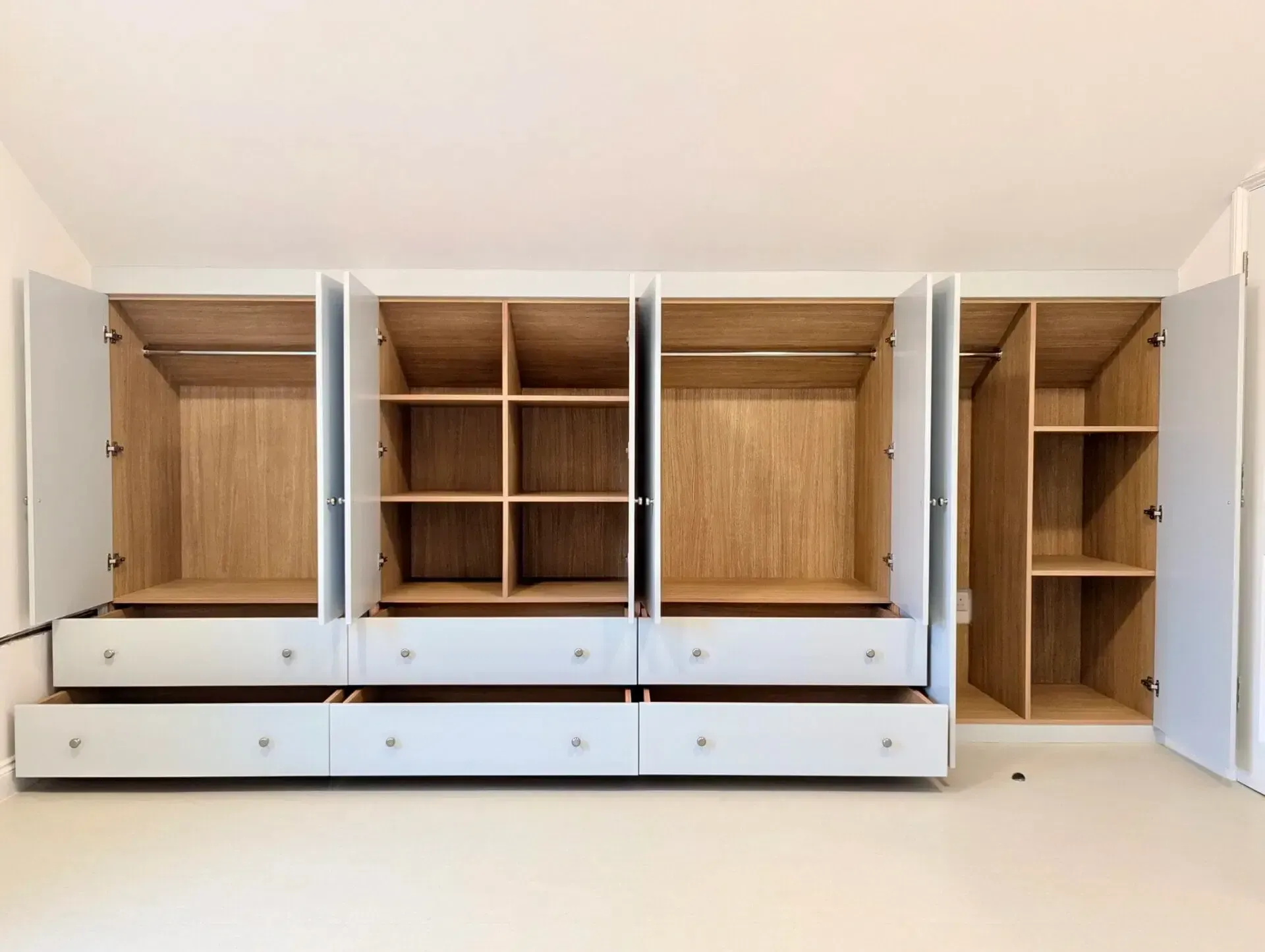
Ask what board type the carcass is built from. The body of a fitted wardrobe — the panels, shelves, and structural frame — is typically made from MDF, moisture-resistant MDF, or a laminated board. Each has different properties in terms of weight, stability, paint adhesion, and how it performs over time in a heated bedroom. A company that can answer this question specifically and explain why they use what they use is demonstrating material knowledge rather than just repeating a sales script.


Ask about the paint finish in detail. Hand-painted and spray-painted finishes produce different results in terms of sheen, smoothness, and durability, and they require different preparation and application processes. Ask whether painting is done in the workshop, on-site, or both. Ask what brand of paint is used and whether it’s a professional-grade trade product. A quality hand-painted finish on fitted furniture is one of its defining characteristics — it’s worth understanding exactly what you’re getting.


Ask about hardware. The hinges, drawer runners, and soft-close mechanisms in a fitted wardrobe affect how it feels to use every single day. Cheap drawer runners drag; quality feather-glide runners open and close smoothly for years. Ask whether the hardware is European-sourced, what load rating the drawer runners carry, and whether soft-close is standard or an upgrade. These are the mechanical components that determine the everyday experience of your wardrobe long after the visual impact of the finish has become familiar.

About the Installation and Aftercare

Ask how long the installation will take and what your home will look like at the end of each day. Fitted furniture installation involves cutting, sanding, and painting — all of which produce dust and mess. Understanding how the installer manages dust — whether they use sheeting, extract equipment, or vacuum as they go — helps you prepare and sets a reasonable expectation. A company whose carpenters treat your home as carefully as their own is worth identifying before rather than after they arrive.


Ask what happens if something goes wrong after installation. Timber moves, paint can chip, and soft-close mechanisms can occasionally need adjustment. Understanding what the company’s aftercare process looks like — whether they have a named person to contact, what the response time is, and how long the workmanship guarantee runs — tells you a lot about how they see the relationship with clients once the invoice is settled.


Ask for references or reviews from people whose homes are similar to yours. A company with genuine experience in Fulham and SW London will have worked in Victorian terraces, Edwardian semis, loft conversions, and modern purpose-built flats across the area. Hearing from someone in a comparable property, with a comparable brief, gives you a more honest picture of what to expect than any brochure or showroom visit can provide.

What Humphries Cabinets Offers

Humphries Cabinets is a family-founded company led by Zephyr Humphries, a third-generation carpenter, and Craig Milton, whose management background keeps every project on track. Every project starts with a free design consultation, full 3D drawings produced before any commitment is required, and a transparent process from design through installation and painting. The company employs its own carpenters and designers and serves homes across Fulham and all of London. See the full range at Fitted Wardrobes, Wardrobe Interiors, and Living Room pages, or contact the team to arrange your free design visit.

Frequently Asked Questions

  • Is it normal to be charged for a design visit and 3D drawings?

    Some companies charge for consultations and drawings; others — including Humphries Cabinets — offer these free as part of the process with no obligation to proceed. If you're being asked to pay before seeing any design proposal, it's worth understanding exactly what that fee covers and whether it's credited against the project cost if you go ahead.

  • What should a good 3D design drawing show?

    At minimum, a 3D drawing should show the wardrobe from the front and at an angle, with dimensions clearly marked, the door style visible, and the interior layout indicated. It should reflect the actual room dimensions — not a standard room — and note any structural features such as chimney breasts, sloped ceilings, or radiators that affect the design. If the drawing looks generic rather than specific to your room, ask whether a more detailed version can be produced.

  • How long does a fitted wardrobe project typically take from consultation to installation?

    Design and manufacture typically takes several weeks once a design is finalised and signed off. The consultation and drawing stage can happen quickly — often within a week or two of the initial visit. The total time from first conversation to installed wardrobe is usually six to ten weeks, depending on the company's current workload and how quickly the design decisions are made.

  • What guarantee should a fitted wardrobe come with?

    A reputable bespoke joinery company should offer at minimum a workmanship guarantee covering the quality of the installation and the furniture itself. Ask specifically how long the guarantee runs, what it covers, and what the process is for raising a concern after installation. Guarantees that are described vaguely in conversation should be put in writing before you sign.

  • Should I get more than one quote before deciding?

    Yes. Getting two or three quotes for a fitted wardrobe project gives you a frame of reference for what's included at different price points and allows you to assess how different companies approach the design conversation. Compare what each quote includes rather than just the total figure — the difference between quotes often lies in the material specification, the paint process, and the hardware quality rather than in the design itself.

  • What happens if I change my mind about part of the design after signing?

    Ask this question specifically and get a clear answer before you sign. Some companies accommodate changes up to a certain stage of manufacture without charge; others treat any post-sign change as a variation with an associated cost. Understanding the revision policy upfront prevents a difficult conversation later.

  • Can I visit any installed examples of the company's work before committing?

    A company confident in the quality of its work should be comfortable arranging a reference visit to a completed installation, or at minimum directing you to a portfolio with genuine photographs of completed projects. Showroom samples and CGI renders give you a partial picture; seeing the actual quality of joinery and finish in a real home is more informative.

Why Choose Humphries Cabinets

The best time to ask hard questions about a fitted wardrobe company is before you sign, not after. The answers will either give you confidence or give you pause — and both outcomes are useful. At Humphries Cabinets, every question asked before a project begins is welcomed. The goal is for every client to feel completely informed before any agreement is reached, and completely satisfied long after installation is finished.


Contact Humphries Cabinets to arrange your free design consultation and ask anything you need to before you commit.

Recent Posts

White paneled closet doors with brass knobs in a hallway
May 30, 2026
Security within a fitted wardrobe is one of those topics that rarely comes up in the design conversation but turns out to matter to a significant number of homeowners once they think about it.
Open kitchen drawer with utensils beside white cabinets and wooden floor
May 30, 2026
The open-plan kitchen-diner is the defining floor plan of modern London home renovation. Knock down the wall between the kitchen and the back reception room
White built-in mirrored wardrobe in a bright hallway with wood flooring and a white door
May 30, 2026
Bathroom storage in London homes is chronically underdesigned. Most bathrooms have a wall cabinet above the basin, a shelf inside the shower, and a towel rail
Cozy living room with two bookcases, fireplace, gray sofa, and bay window with red curtains
May 30, 2026
Fulham and the surrounding boroughs of Hammersmith, Kensington, Chelsea, and Wandsworth contain some of the highest concentrations of conservation areas in London.
White paneled built-in wall unit with shelves and window blinds in a bright room
May 30, 2026
Purpose-built flats — the kind built in London between the 1930s and the 1990s — are not designed with fitted furniture in mind.
White paneled closet doors with brass knobs in a hallway
May 30, 2026
Georgian and Regency properties are among the most architecturally specific homes you can commission fitted furniture for.
Built-in white closet with open shelves, hanging rods, and small wooden drawers in a bright room
May 30, 2026
Most people turn up to a design consultation having done very little preparation — and that’s fine. The designer’s job is to take accurate measurements, assess the space, and translate your storage needs into a workable design.
Minimalist bedroom with large dark wood built-in wardrobe and light gray walls
May 30, 2026
Most people commission fitted wardrobes at one of two moments: when they’ve lived in a home long enough to know exactly what the storage problems are, or when they’ve just moved in and want to get it right from the start.
Bright white walk-in closet with open shelves, hanging clothes, and a central drawer dresser
May 30, 2026
The design visit went well. You liked the designer, the drawings look right, and the quote has landed in your inbox. At this point, most people sign.
Bright hallway with mirrored wall panels, beige walls, and two blue ottomans.
April 30, 2026
There's a tier of fitted furniture beyond even a full wall of wardrobes: the dressing room. An entire room — or a generous walk-in extension of a bedroom — given over to clothes, shoes, accessories, and the routines of getting dressed.
Show More