Fitted Wardrobes for Georgian and Regency Homes: Proportions, Cornicing and Character
Georgian and Regency properties are among the most architecturally specific homes you can commission fitted furniture for. The rooms are tall — often 2.8 to 3.2 metres or more on the principal floors. The proportions are deliberate and mathematical, governed by classical principles of symmetry that were applied not just to facades but to interior layouts, window heights, and the relationship between architectural elements. A wardrobe that works in a Victorian terrace bedroom looks wrong in a Georgian drawing room conversion, and the reasons are specific rather than vague.
London has an exceptional concentration of Georgian and Regency properties — from the grand terraces of Islington and Bloomsbury to the mansion blocks of Kensington and the smaller but equally well-proportioned houses of Canonbury and Barnsbury. Each presents the same fundamental challenge for fitted furniture: how do you introduce storage into a room whose architectural character was established 200 years ago, without making it obvious that something new has been added? At Humphries Cabinets, this is one of the most satisfying briefs to work with — and the one that rewards careful thought about proportion, profile, and finish most richly.
Understanding Georgian Proportions
Georgian architecture follows the classical orders — a system of proportional relationships between elements that creates visual harmony. Rooms in a Georgian house tend to have ceiling heights that are roughly 1.5 times the width of the room, windows that rise to within a controlled distance of the ceiling, and architectural details — cornices, picture rails, dado rails, skirting boards — that are proportioned relative to the room height. All of this means that a fitted wardrobe in a Georgian bedroom needs to be thought about not just as storage furniture but as an architectural element in its own right.
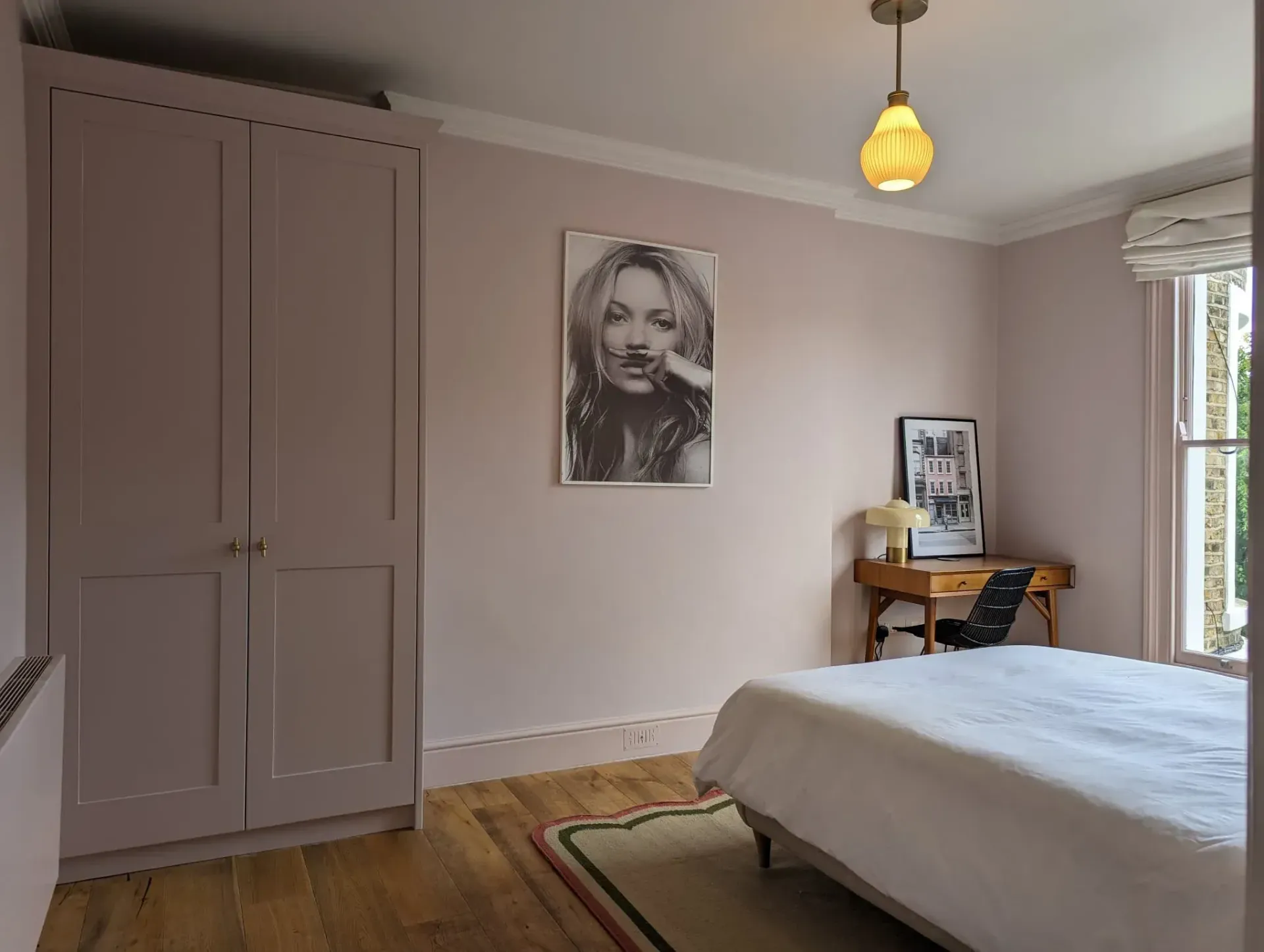
A full-height wardrobe in a Georgian room with a 3-metre ceiling can look extraordinary — but only if the proportions of the wardrobe doors, panels, and cornice relate correctly to the room. Wardrobe doors that are too wide for their height, or a cornice profile that is too small relative to the ceiling moulding above, will look wrong in a way that’s hard to articulate but easy to feel. The design conversation for a Georgian property always begins with the room’s existing proportions and works from there.
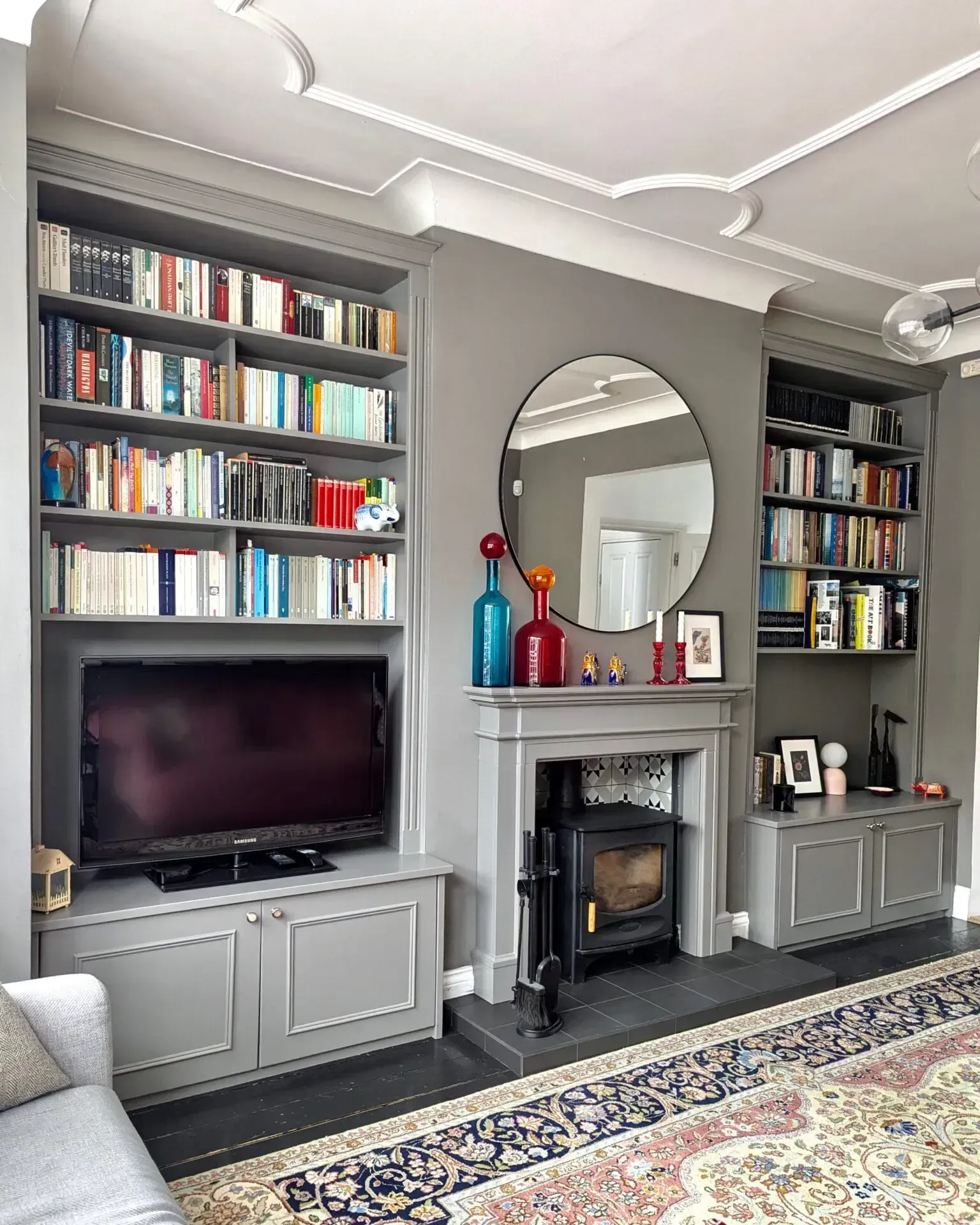
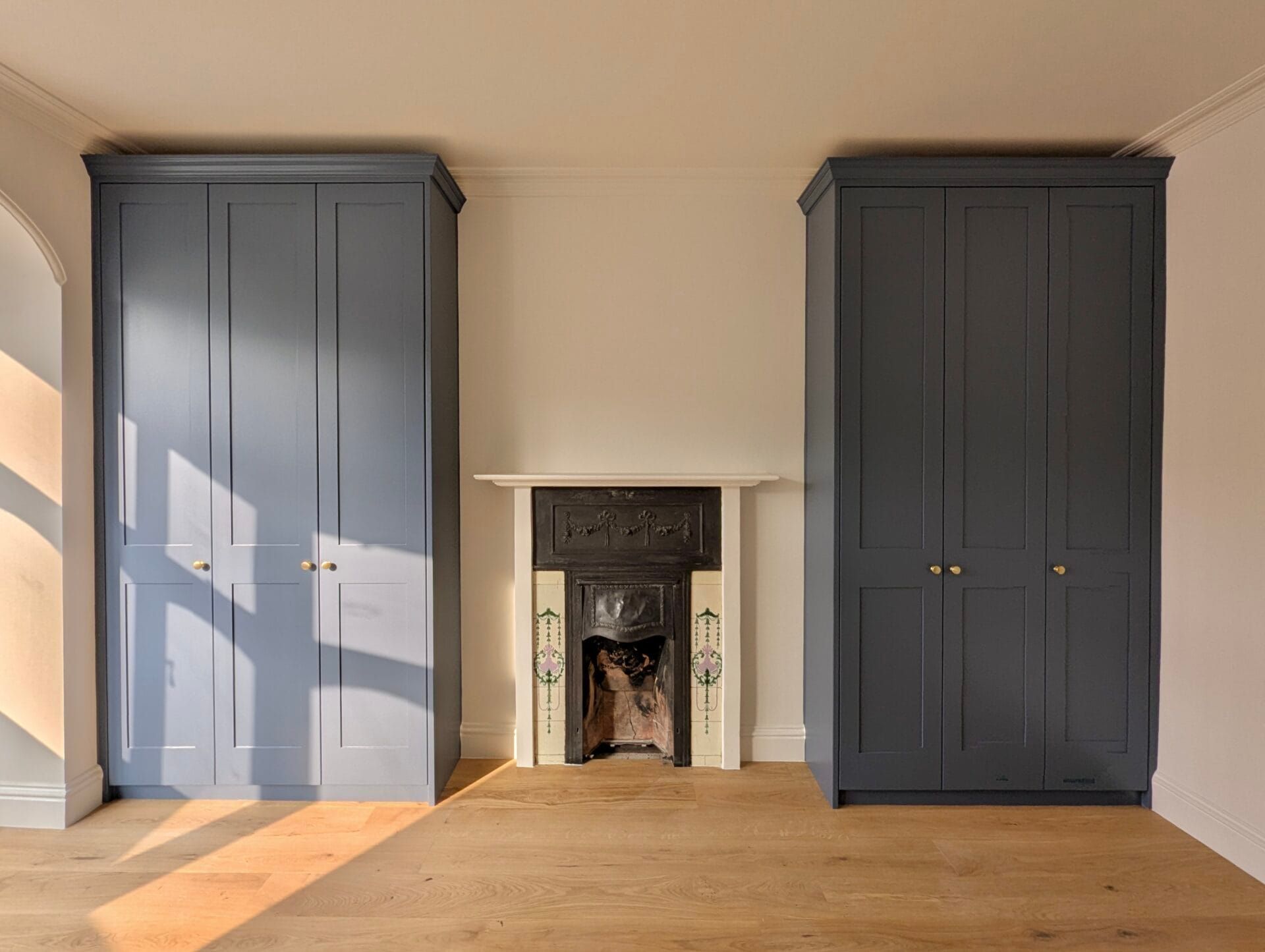
Symmetry is particularly important. Georgian rooms are designed around a central axis — the fireplace is typically the focal point, positioned centrally on one wall, with windows symmetrically placed on another. A fitted wardrobe that runs asymmetrically across a wall, or that interrupts a symmetrical arrangement without acknowledging it, creates visual tension in a room that was designed to be resolved. Alcove wardrobes, either side of a chimney breast, are almost always the right answer in a Georgian bedroom — they honour the symmetry while providing excellent storage on both sides.
Cornicing: How to Handle the Junction at the Top
The cornice in a Georgian room is not decoration — it’s structure. It’s the transition between the wall plane and the ceiling, and in a well-proportioned Georgian room, it’s scaled to be noticed. A wardrobe installed in such a room needs to relate to that cornice deliberately, not ignore it. There are essentially three approaches: run the wardrobe to the underside of the existing cornice, removing the section of original cornice that the wardrobe covers and finishing cleanly at the junction; run the wardrobe through the cornice to the ceiling, scribing the cabinet around the existing moulding; or add a matching cornice profile to the top of the wardrobe that references the room’s original moulding.
The third option — a matching or complementary cornice profile on the wardrobe top — is the most elegant in a room where the original cornicing is intact, and you don’t want to disturb it. A cornice profile that references the scale and style of the existing moulding makes the wardrobe read as part of the room’s architecture rather than a late addition to it. This requires a designer and carpenter who understand how classical moulding profiles work and can specify something appropriate rather than defaulting to whatever profile comes with the standard cabinet.
In properties where the original cornice has already been removed or damaged, this decision is simpler. The wardrobe can run floor to ceiling and contribute its own cornice profile to the room, which is often a net improvement over the situation it replaces. But where original Georgian cornicing is intact — particularly in listed buildings or conservation area properties — preserving it while fitting the wardrobe sympathetically is both an aesthetic and sometimes a regulatory requirement.
Panel Details and Door Styles
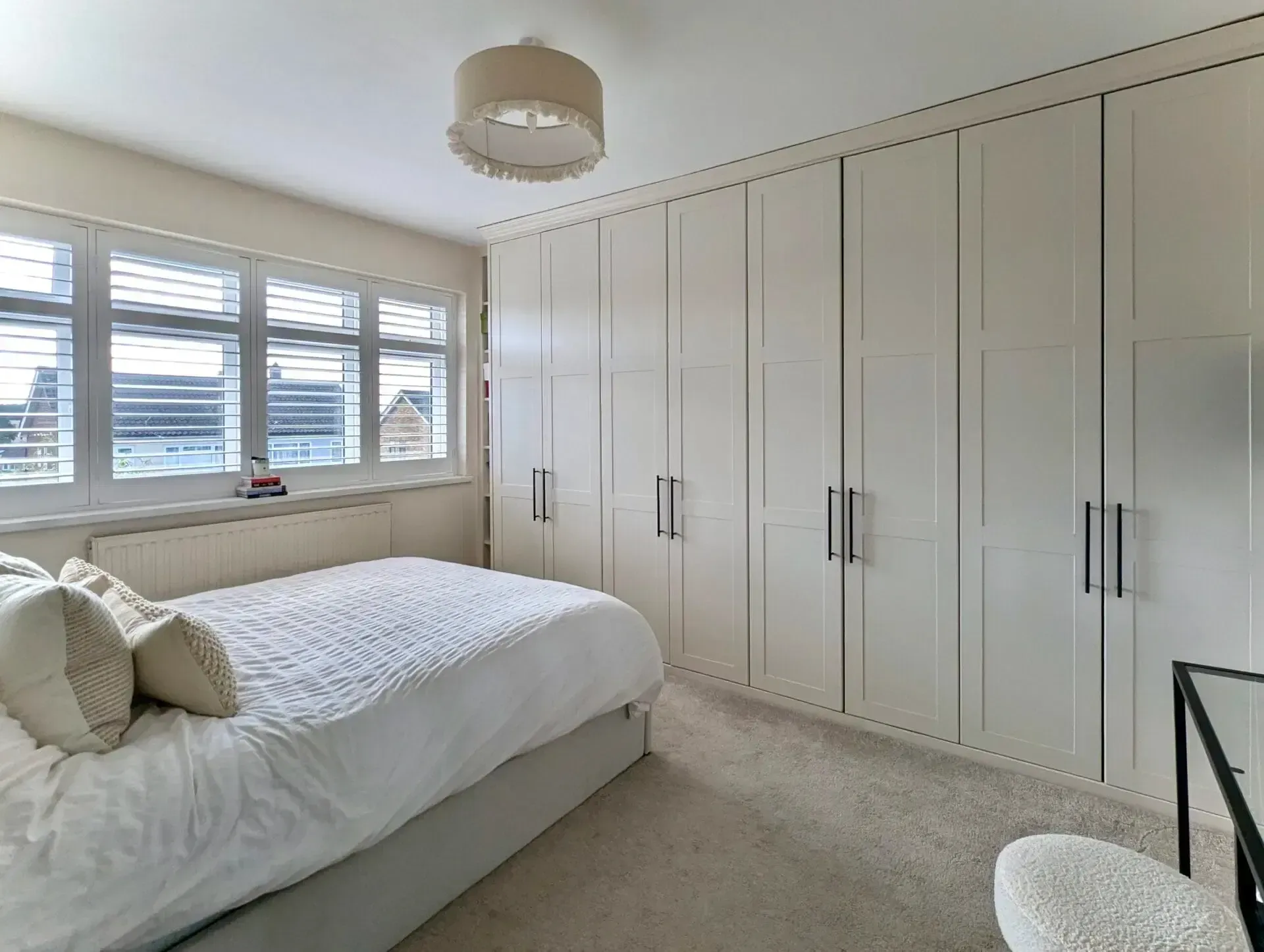
The flat, Shaker-style door is the most common modern choice for fitted wardrobes, and it works well in a wide range of period and contemporary interiors. But in a Georgian room, the Shaker panel — with its clean recessed centre and minimal frame — can sometimes look too restrained relative to the room’s decorative ambition. Georgian joinery typically features more elaborate panel arrangements: raised-and-fielded panels, ovolo mouldings around panel edges, and architraves with specific classical profiles.
A wardrobe designed for a Georgian bedroom doesn’t need to replicate the exact profile of an original door, but it should acknowledge the register of decorative detail in the room. A door with a more pronounced panel moulding, or a more detailed frame treatment, sits more comfortably in a Georgian room than a plain flush panel. Fluted columns between wardrobe sections, which Humphries Cabinets produces as part of their standard offering, can reference the pilaster detailing common in Georgian interiors without being a literal copy of it.
Handle selection also matters in this context. A small, understated knob or a delicate bar handle in aged brass or unlacquered brass suits the material palette of a Georgian interior far better than a brushed steel bar or a contemporary minimal pull. These are small decisions that have a large cumulative effect on whether a wardrobe feels like it belongs in the room or merely occupies it.
Colour and Finish in a Georgian Room
Georgian interiors were not neutral. The period produced some of the most distinctive and deliberate colour palettes in English interior history — the deep, earthy tones of the early Georgian period, the more refined and lighter colours of the Regency era. A fitted wardrobe in a Georgian room can either blend with the walls — particularly effective in a room with tall ceilings where the wardrobe disappears into the wall plane — or contrast deliberately with a colour that references the period palette.
Deep greens, rich blues, off-whites, and warm greys all work well in Georgian rooms, and all are achievable in a hand-painted wardrobe finish. The finish quality matters particularly in rooms with this level of architectural character — a rough or uneven paint job stands out badly against the precision of original Georgian joinery. A proper hand-painted finish, applied correctly with the right preparation and the right number of coats, is the only appropriate choice for a wardrobe in a room of this quality.
What Humphries Cabinets Offers
Humphries Cabinets designs and installs fitted wardrobes across London, including in Georgian and Regency properties, working with the architectural character of each room. Cornice profiles, panel detailing, fluted columns, and handle selection are all part of the standard design conversation. Hand-painted finishes, oak-effect laminates, and a full range of wardrobe styles are available. See Fitted Wardrobes, Shaker Style Wardrobes, and Wardrobe Interiors, and contact the team to arrange your free design visit.
Frequently Asked Questions
Do I need listed building consent to fit a wardrobe in a Georgian property?
Not automatically. Listed building consent is only required if your property is individually listed — conservation area status alone does not trigger this requirement. If the property is listed, consent may be needed for internal alterations, particularly if the work affects original historic fabric such as original panelling or mouldings. Check your listing entry and consult the local conservation officer if you're uncertain.
How do you match a wardrobe cornice to the existing room cornicing?
The key is to reference the scale and proportion of the existing moulding rather than copy it exactly. A cornice that is in the same stylistic register — similar depth, similar projection, similar profile style — sits comfortably alongside the original without needing to be an identical match. A joinery company experienced in period properties will have access to a range of cornice profiles and can advise on the closest appropriate option.
What door panel style suits a Georgian bedroom best?
A panel with a more pronounced moulding treatment — an ovolo or bolection profile around the panel edges, or a raised-and-fielded centre panel — is more appropriate than a plain Shaker panel in a room with strong Georgian character. Fluted pilasters between wardrobe sections reference the classical detailing common in Georgian interiors and work well at the scale of a full-wall wardrobe.
Can a fitted wardrobe go floor to ceiling in a room with a 3-metre ceiling?
Yes, and in many cases this is the best approach. A full-height wardrobe in a tall room reads as an architectural element rather than a piece of furniture. The cornice at the top of the wardrobe becomes the visual stop, tying the unit to the ceiling line in the same way as the room's original cornice does. The result is a wardrobe that looks as if it was always part of the building.
What paint colours work well in Georgian bedrooms?
Georgian and Regency interiors historically used deep, saturated colours — Prussian blue, bottle green, burnt ochre, off-whites with a warm or cool undertone depending on the period. These palettes translate well to fitted wardrobes. Deep greens and rich blues work particularly well in tall rooms, where the colour grounds the room without making it feel smaller. Off-whites in a warm or stone tone read as appropriately restrained for a Regency interior.
How do you handle a wardrobe around a window in a Georgian room where windows are large?
Georgian windows are typically tall and positioned deliberately within the wall. Running a wardrobe across a wall that includes a window requires either stopping the wardrobe short of the window on each side and using the window reveal as a natural break, or designing specifically around the window — potentially incorporating a window seat below the sill as part of the wardrobe run. The right approach depends on the window position, the wall width, and the storage priority.
Is a shaker door appropriate for a Georgian property?
It can work, but it's worth considering whether the Shaker panel's relatively plain profile is proportionate to the room. In a Georgian room with elaborate cornicing and detailed skirting boards, a very plain Shaker door can look understated to the point of looking like it belongs in a different building. A Shaker with a more pronounced moulding detail around the panel, or a different panel treatment altogether, may be more appropriate.
Why Choose Humphries Cabinets
A fitted wardrobe in a Georgian home is a project where getting the proportions, the profile, and the finish right makes the difference between something that enhances a room of real architectural quality and something that diminishes it. At Humphries Cabinets, the design process for period properties is taken as seriously as the carpentry — because the two are inseparable.
Contact Humphries Cabinets to arrange your free design consultation for your Georgian or Regency home.