
How to Compare Fitted Wardrobe Quotes: A London Homeowner's Guide

August 30, 2026

Share this article

Getting quotes from multiple fitted wardrobe companies is standard practice for any substantial project. What's less standard is knowing how to actually compare those quotes against each other in a way that reveals what you're really being offered — and where the meaningful differences lie between suppliers.


On the surface, most fitted wardrobe quotes look similar. They describe the work, list the materials, specify the finish, and quote a total price. But dig beneath the surface and the differences between quotes can be substantial. Two quotes for the same room can differ by thousands of pounds not because one supplier is overcharging, but because the underlying specifications are meaningfully different. Homeowners who accept the lowest quote without understanding these differences often discover the compromise only after installation, when it's too late to change direction.


This guide walks through what to look for when comparing fitted wardrobe quotes, the specifics that separate serious quotes from cursory ones, and the practical realities that most homeowners aren't told about how the industry actually prices its work.

The chimney breast alcoves

A properly detailed fitted wardrobe quote should specify enough information that another supplier could replicate the exact project from the documentation alone. If your quotes don't include this level of detail, you're comparing incomplete information.


Detailed dimensions of every component. Not just the overall wardrobe dimensions, but the width of each door section, the height of hanging rails, the depth of drawers, the number and position of shelves. Without this, "a fitted wardrobe wall" can mean substantially different things.


Specific material and substrate details for every visible component. What is the door made from? What is the carcass made from? Is oak solid or veneered? What grade of MDF is being used? These details drive both cost and long-term durability.


Finish specifications including the type of finish, the number of coats, and the application method. "Spray-painted" is different from "brushed and rolled." The paint colour should be specified by manufacturer reference and code.


Hardware specifications including hinges (brand, model, weight rating), door mechanisms (soft-close type), drawer runners (brand, weight rating, extension type), handles (specific model or measurement), and any integrated features such as internal lighting.


Installation scope covering exactly what work is included, what preparation is required from the homeowner, and what's specifically excluded. Is electrical work included? Is decoration touch-up around the wardrobe included? Is the removal of existing furniture included?


Timeline commitment including design lead time, manufacturing lead time, and installation duration. A quote without timeline is a quote without commitment.


Payment terms including deposit percentage, milestone payments, and final settlement terms.


Warranty specifications covering exactly what is guaranteed and for how long. Carcass, doors, hardware, and finishes may have different warranty periods.


If a quote lacks any of these categories, it's truly incomplete — not just brief. Ask for the missing information before making comparisons.

Understanding Where Cost Differences Actually Come From

Substantial cost differences between quotes usually come from a small number of specific factors. Understanding these helps you see whether you're being offered better value or being asked to pay more for equivalent work.


Substrate quality varies more than most homeowners realise. Standard MDF, moisture-resistant MDF, and higher-grade materials such as birch plywood all have different cost implications and different long-term durability. A wardrobe built from higher-grade substrate will cost more but will maintain its structural integrity for considerably longer.


Finish application method produces meaningful cost differences. Spray-painted finishes require specialist workshop equipment, longer preparation time, and skilled application. Brushed or rolled paint requires less specialist equipment but produces measurably lower-quality results. The cost difference reflects real underlying process differences.


Hardware grade varies enormously. Budget hinges, drawer runners, and soft-close mechanisms cost a fraction of premium equivalents from established brands like Blum, Hafele, or Grass. The functional difference over years of daily use is substantial — cheaper hardware fails earlier and often develops issues that affect how the wardrobe operates.


Construction method affects both cost and quality. Wardrobes built as separate carcasses installed together produce less refined results than wardrobes built as continuous integrated construction. The difference shows in door alignment, gap consistency, and long-term stability.


Design and drawing quality vary between suppliers. Detailed 3D drawings, multiple design iterations, and thorough site measurement all take time and cost money. Suppliers who skip these stages produce quotes that look cheaper on paper but often require significant on-site adjustments during installation that affect the finished result.


Installation skill and time differ between suppliers. Some suppliers install quickly with minimal on-site adjustment. Others take longer to scribe properly to irregular walls, level carefully, and produce a truly integrated finish. The cost difference reflects real differences in the installation quality.

Warning Signs in Low Quotes

Several specific patterns should raise concern when comparing quotes.


A quote substantially lower than the others deserves careful investigation. Fitted wardrobe pricing across established suppliers usually falls within a reasonable range for equivalent specifications. A quote 30% or 40% below others typically indicates meaningful differences in specification, quality, or scope that aren't obvious from the paperwork.


Vague material descriptions such as "quality MDF" or "premium finish" without specific grades and brands. Established suppliers name their materials precisely because they're proud of what they use. Vague descriptions often indicate that specifics would reveal budget choices.


Missing hardware brand names for hinges, drawer runners, and soft-close mechanisms. Quality hardware is always specified by brand and model. Generic hardware descriptions often indicate budget mechanisms that will fail earlier.


Compressed timelines that promise installation within a few weeks of order. True bespoke fitted wardrobes require design time, manufacturing time, and coordination that can't be rushed without compromising quality. Compressed timelines often indicate modular construction being presented as bespoke.


Aggressive deposit demands requesting large percentages upfront before design work is complete. Reasonable deposit structures typically request modest amounts to secure the design work, with the majority of payment tied to manufacturing and installation milestones.


Reluctance to visit the site before quoting. Suppliers who quote from photographs or rough sketches without visiting the actual room are producing prices based on assumptions rather than measurements. The gap between assumption and reality often shows up as unexpected costs later.


Vague or missing warranty terms. Established suppliers stand behind their work with clear warranties. Vague warranty language often indicates that claims will be difficult to enforce.

Questions to Ask Every Supplier

The same set of questions asked of every supplier reveals meaningful differences between quotes.

  • How long have you been operating, and how many projects like mine have you completed?

    Experience with similar projects matters, particularly for period properties, listed buildings, or unusual specifications.

  • Who will actually build my wardrobes, and who will install them?

    Some suppliers subcontract manufacturing or installation, which affects both quality control and accountability. Suppliers with in-house teams typically produce more consistent results.

  • Can I visit your workshop or see completed installations?

    Established suppliers are generally willing to demonstrate their work. Reluctance often indicates something worth investigating.

  • What happens if there are issues during or after installation?

    Understanding the process for addressing snagging, warranty claims, and post-installation adjustments reveals how the supplier operates.

  • What's your policy on design changes during the project?

    Changes are common in fitted furniture projects. Understanding how they're handled prevents disputes later.

  • Can I speak to recent customers?

    Suppliers with good work are typically willing to connect prospective clients with recent customers. This provides direct evidence of actual experience.

The Design Visit as Comparison Tool

One of the best ways to compare suppliers is to observe their design visit behaviour rather than just their paperwork.


How thorough is the measurement process? A supplier who spends 20 minutes measuring is unlikely to produce the same quality of installation as one who spends two hours. Careful measurement is the foundation of good fitted furniture.


How specific are the design questions asked? Suppliers who ask detailed questions about what you own, how you use the room, and what frustrations the current storage creates are producing designs based on your actual needs. Suppliers who present standard solutions without these questions are producing generic designs.


How much time is spent discussing options and trade-offs? Design conversations should feel like consultations, not sales presentations. Suppliers who explain the reasoning behind their recommendations are typically producing better-considered work.

How quickly is the quote produced? A quote produced within hours of the design visit usually indicates standard pricing rather than considered specification. Detailed quotes for bespoke work typically take days to produce properly.


What documentation is provided at the design stage? Detailed 3D drawings, dimensioned plans, and specification documents demonstrate the supplier's process. Suppliers who quote without visual documentation are asking you to commit to substantial work without seeing what you're getting.

The Value of Local, Established Suppliers

Several practical considerations favour local, established fitted furniture suppliers over larger national alternatives.


Local suppliers understand local property types. A supplier who works regularly in London Victorian terraces understands the specific challenges those properties present. A national supplier applying standard specifications may struggle with the same properties.


Established suppliers have skin in the game. A supplier who has operated for many years locally has built a reputation they need to protect. This affects everything from installation care to post-installation service.


Local suppliers are accessible for follow-up. Small adjustments, minor repairs, and years-later modifications are all easier when the supplier is local and established. National suppliers who use different subcontractors for different regions provide less consistent service.


Local pricing includes proper site knowledge. Suppliers who don't know local property types often include contingency premiums to cover unknowns. Local suppliers price more accurately because they understand what they're actually working with.

Making the Final Decision

After comparing quotes properly, the decision often comes down to a small number of factors.


Total value rather than lowest price. The cheapest quote is rarely the best value for a project you'll live with for decades. Focus on what you're actually getting for the price.


Confidence in the supplier's capability. The design visit, the documentation quality, the answers to your questions all contribute to a sense of whether a supplier can actually deliver what they've quoted.


Alignment with your priorities. Different suppliers emphasise different things. Some prioritise design flexibility; others prioritise installation efficiency; others prioritise finish quality. Match the supplier's strengths to what matters most for your project.


Practical fit with your timeline and budget. The best supplier in principle may not fit your specific project constraints. Practical fit matters as much as quality.


Your instinct after meeting the team. Fitted furniture projects involve extended contact between the supplier and the household. Suppliers you feel comfortable with typically produce better outcomes than suppliers who impressed you on paper but felt uncomfortable in person.

What Humphries Cabinets Offers

We provide detailed fitted furniture quotes based on thorough site visits and full documentation. Our services include:


Every quote we produce includes detailed dimensions, specific material and hardware specifications, finish details, timeline commitments, and warranty terms — so you can compare our work against other suppliers on equivalent terms.

Why Choose Humphries Cabinets

At Humphries Cabinets, we welcome comparison against other suppliers because we're confident in the specification and quality of the work we deliver. Our design visits are thorough, our documentation is detailed, and our finished installations reflect the specifications we quoted. We handle design, manufacture, and installation in-house, which means the person promising the work is the person accountable for delivering it.


If you're comparing fitted wardrobe quotes for your London home and want a supplier who will provide complete documentation for proper comparison, contact us today to arrange your free consultation.

Recent Posts

Bright home office with white bookshelves, desk, chair, window, curtains, and blue bench
August 30, 2026
Discover fitted home office storage for hybrid workers in London, with bespoke solutions that maximize space, organize essentials, and support productive work.
Bright white bedroom with mirrored closet doors, wooden dresser, and open doorway to a sunlit room
August 30, 2026
Compare spray-painted and hand-painted fitted wardrobes to understand differences in finish, durability, consistency, cost, and the best choice for your home.
Light wood wardrobe with mirrored doors, reflecting a small desk in a bright room.
August 30, 2026
Explore the complete guide to fitted wardrobe handles and hardware, covering styles, finishes, functionality, durability, and tips for choosing the right options.
Bright bedroom with a bed, wardrobe, portrait on the wall, and a desk by the window.
August 30, 2026
Discover fitted wardrobes for Edwardian and Georgian London homes, combining period character with practical storage and bespoke designs that suit your space.
Bright bedroom with built-in wardrobes, white bed, and large window with blinds
August 30, 2026
Discover fitted wardrobes for small London bedrooms, with space-saving designs that maximize storage, improve organization, and make compact rooms feel larger.
Gray living room with built-in bookshelves, fireplace, TV, mirror, and patterned rug
August 30, 2026
Explore entertainment units and media storage for London homes, with bespoke designs that organize devices, conceal cables, and complement your interior.
Modern home office with built-in bookshelf, desk, chair, and large window overlooking greenery
August 30, 2026
Explore bespoke bookcases and home libraries for London homes, with custom designs that maximize storage, complement your décor, and create a stylish space.
Open white wardrobe with empty wooden cabinets and drawers in a bright room
August 30, 2026
Learn how fitted wardrobe internal layouts should work, with smart storage, practical compartments, easy access, and designs tailored to your needs.
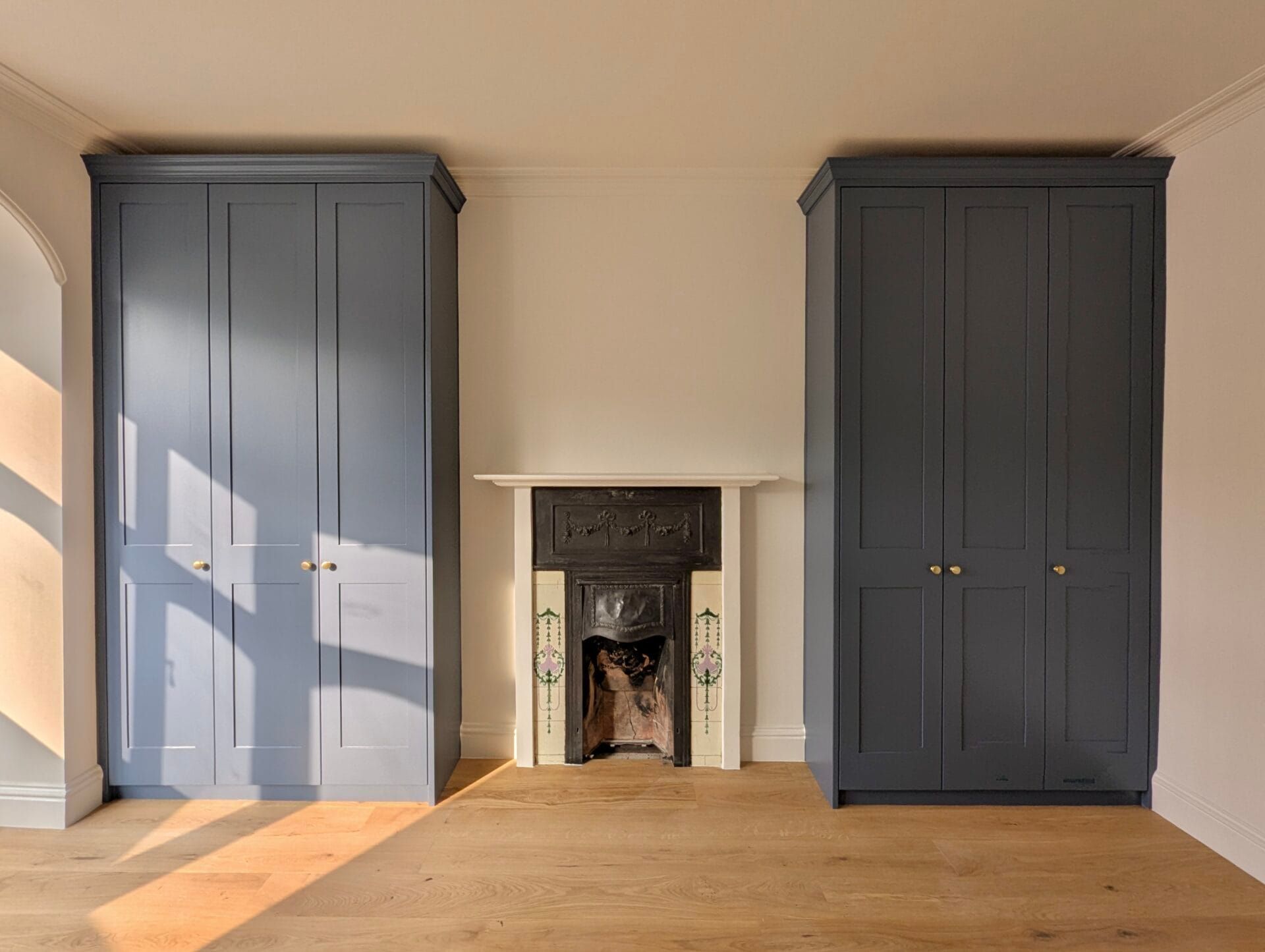
Room with two dark built-in wardrobes and a small fireplace in the center, lit by sunlight on the wooden floor
August 30, 2026
Compare oak and painted fitted wardrobes for your London home, including style, durability, maintenance, and cost to choose the right option for you.
Living room with white built-in bookshelves, a fireplace, framed art, and a lamp beside a sofa.
August 4, 2026
Fulham and Hammersmith homes have specific storage problems — narrow terraces, chimney breast alcoves, conversion flats and loft rooms. Here's how fitted furniture solves each.
Show More