Shoe Storage: Designing It Into Wardrobes and Hallways
How should shoe storage be designed into fitted furniture?
Split shoes by frequency, not by type. Everyday pairs belong near the front door in shallow, ventilated drawers or open racks; occasional and smart pairs belong in the
bedroom wardrobe where they stay clean and dust-free. Count your pairs before designing, measure the tallest boots you own, and allow for growth — shoe storage is the section people outgrow fastest.
Shoes defeat more storage schemes than anything else in a house. They arrive wet, they arrive dirty, they multiply, and they end up in a heap by the front door regardless of what was designed for them.
Solving it properly starts with a distinction most people never make.
Split by frequency, not by type
The instinct is to store all shoes together. It is almost always wrong.
Everyday shoes — the three or four pairs actually in rotation — need to live where you take them off, which is by the front door. If they have to be carried upstairs, they will not be.
Occasional and smart shoes belong in the bedroom, where they stay clean and out of the way.
Seasonal footwear — walking boots, sandals, wellingtons — can go somewhere less convenient entirely.
Design for those three groups separately and the pile by the door disappears. Design for one undifferentiated "shoe cupboard" and it does not.
The test is not what the shoes are but how often they move. A pair worn daily and a pair worn twice a year have almost nothing in common as a storage problem, even if they sit on the same shelf in the shop. Sort your own collection that way for five minutes, and the design brief writes itself: a small amount of very accessible storage downstairs, a larger amount of tidy, protected storage upstairs, and somewhere out of the way for the bulky seasonal things.
When there is no hallway to speak of
Plenty of London flats have no hall at all. The front door opens into the living room, or into a stub of corridor with a radiator on one wall and a door on the other, and there is nowhere obvious for anything to go.
The answer is usually to stop looking for a cupboard and start looking for a wall. A shallow run on the return beside the door — hooks or a short rail above, ventilated shoe storage below, a bench between them — takes very little depth and solves the whole arrival problem. Understairs space, where there is any, is the other candidate, and it holds far more than it looks as though it should once it is built to the rake of the stairs.
What matters is that the storage sits where people actually take their shoes off. Anything more than a few steps from the door gets ignored, however well made it is, and the pile forms exactly where it always did.
In the hallway
Hallway storage is where the everyday pairs need solving, and it is always depth-constrained because whatever you build has to leave a comfortable route past it. Hallway units are designed with hanging rails, drawers and shoe racks together for exactly this reason — coats and shoes are the same problem arriving at the same moment.
Three things matter here:
Ventilation. Shoes come in wet. A completely sealed cupboard by a front door will hold that dampness. Ventilated fronts or an open lower section let them dry.
Shallow depth. A shoe on its side takes far less depth than a shoe facing forwards. Tilting racks and shallow drawers are how a slim hallway unit holds a surprising number of pairs.
Somewhere to sit. A bench over the shoe storage is the detail people appreciate most, and it costs almost nothing to design in. In a narrow London hallway, it turns a corridor into something usable.
Wet, muddy and outdoor footwear
The hallway problem is not really storage. It is that shoes arrive in a condition nothing else in the house arrives in.
Give them somewhere to drip. A removable tray in the base of a hallway unit can be lifted out and rinsed; a fixed painted base cannot. It is a small detail at design stage and the difference between a cupboard that stays presentable and one that does not.
Design for the bulky outliers. Wellingtons, walking boots and football boots take up a disproportionate amount of space and are needed rarely. They are usually better in a taller, plainer section — or somewhere else entirely — than competing with everyday pairs at the front door.
Account for children. Small shoes are numerous, outgrown constantly and always urgent. A low, open section that a child can reach without help saves an adult a job every morning, and it stops the everyday pile forming at knee height by the door.
Think about the dog. If there is one, the lead, the towel and the muddy boots are the same problem arriving at the same moment, and a hallway unit that acknowledges them is worth considerably more than one that does not.
In the wardrobe
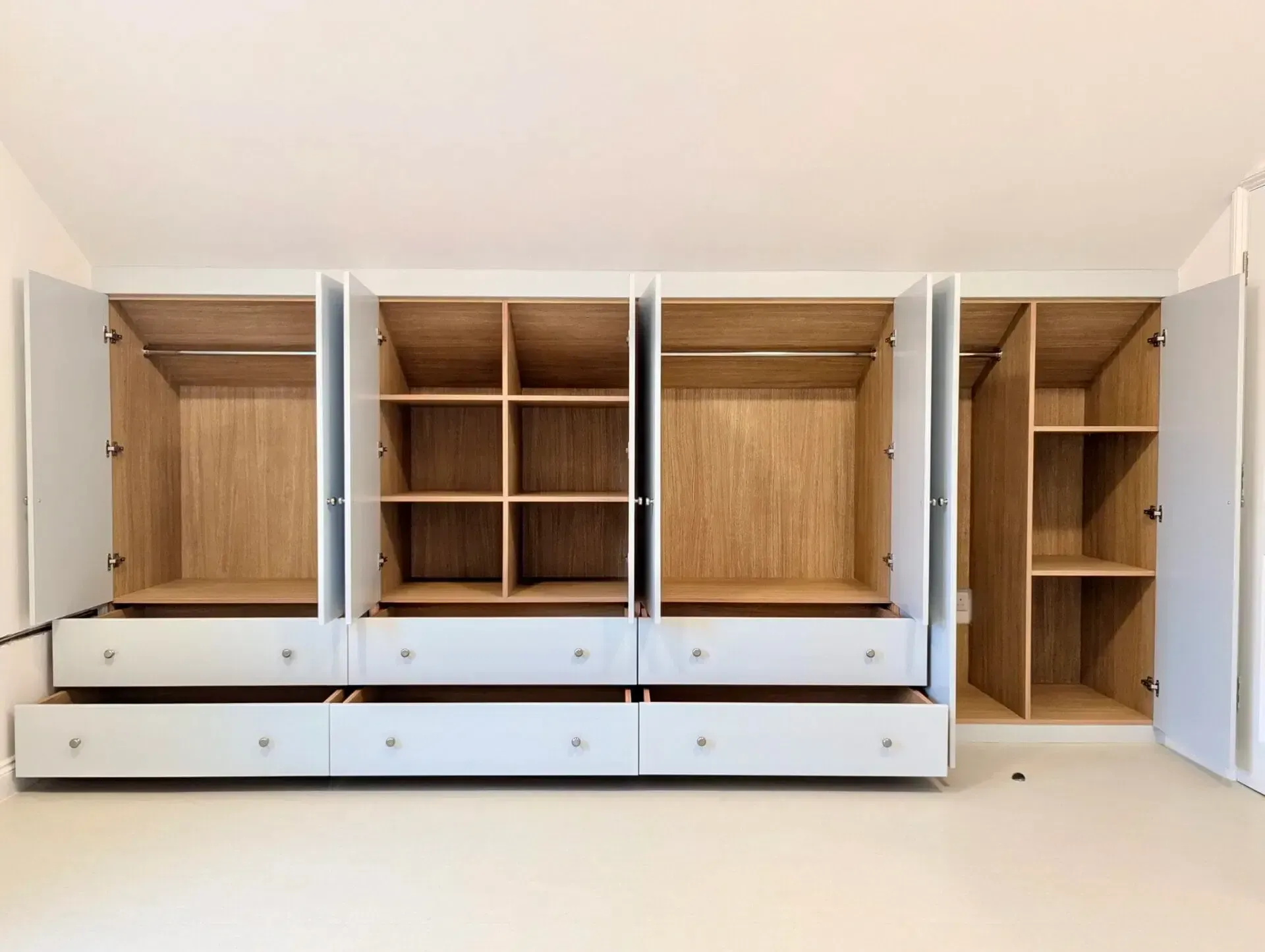
Inside a fitted wardrobe, shoe storage competes with hanging and drawers, so it needs to be sized honestly.
Pull-out trays on runners bring the back pairs forward, which solves the fundamental problem of a deep shoe shelf — you cannot see or reach what is at the back. This is where good hardware matters: full-extension runners mean the whole tray comes out, not two-thirds of it.
Adjustable shelves let you change the spacing as your collection changes. Flat shoes need very little height; boots need a lot.
A dedicated boot section. Tall boots are the item most often forgotten at design stage. Measure your tallest pair before the consultation — it is the single measurement that most often forces a redesign afterwards.
Consider whether you want them visible. Some people want shoes on display behind glass or open shelving; others want them entirely hidden. It changes the design, and it is worth deciding early.
Keep the good pairs off the floor of the wardrobe. Shoes standing directly on a wardrobe base end up being kicked about, and they make the whole run harder to clean. A dedicated shelf or tray costs almost nothing in space and keeps the section looking deliberate.
Counting properly
Almost everyone under-counts. Before your consultation:
Count every pair in the house, including the ones in boxes and under the bed
- Note how many are tall boots
- Note how many are genuinely everyday
- Add a realistic margin — shoe collections grow
Bring that to the design consultation, where storage needs and the architecture of the space are worked through together. Shoes are the easiest thing to design well and the easiest to get wrong by guessing.
Storage that keeps shoes in good condition
Good shoes are expensive, and poor storage shortens their life more than wearing them does.
Air matters. Leather needs to dry out between wearings. Sealed plastic boxes and airtight cupboards trap moisture against the material, which is how good shoes develop a smell or a bloom of mould in a matter of months. Ventilated fronts, slatted shelves or simply not packing the section solid all help.
Don't stack. Shoes piled on top of one another lose their shape, and the pair at the bottom is the pair you stop wearing. One pair per slot, visible, is worth more than twice the capacity arranged badly.
Leave height for shoe trees. If you use them — and for leather shoes they are the single best thing you can do — the shelf spacing has to allow for them. It is a small allowance that is impossible to add later on fixed shelving.
Keep the boots upright. Tall boots folded over at the ankle crease permanently. A full-height section is not a luxury for anyone who owns a good pair.
None of this changes the footprint much. It changes the shelf spacing, the ventilation and whether the section is adjustable — all decisions made once, at design stage.
The details that make the difference
Keep everyday pairs at an easy height. Bending to floor level with a bag in one hand is why shoes end up on the floor instead. The section you use every day should be the one you can reach without thinking about it.
Give the cleaning kit a home too. Polish, brushes, a shoe horn, spare laces and waterproofing spray all belong with the shoes rather than under the sink. A single shallow drawer in the hallway unit is usually enough, and it is the difference between shoes that get looked after and shoes that do not.
Leave room to expand. Of everything in a fitted wardrobe, shoe storage is the section people outgrow first — which is an argument for adjustable shelving in that section above any other.